6 Pillars of Good Health: A Warm Heart Through Lasting Social Connections

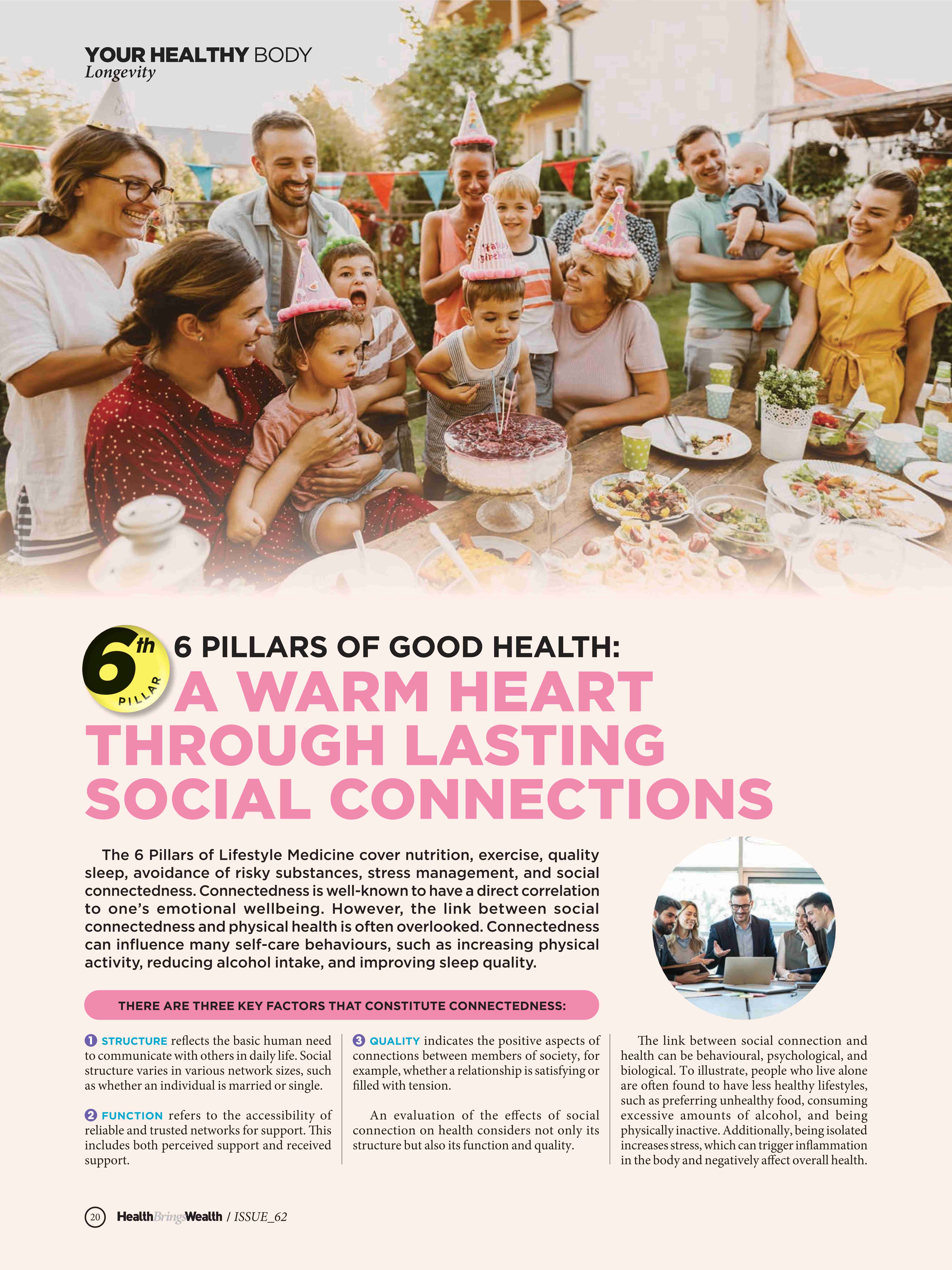
The 6 Pillars of Lifestyle Medicine cover nutrition, exercise, quality sleep, avoidance of risky substances, stress management, and social connectedness. Connectedness is well-known to have a direct correlation to one’s emotional wellbeing. However, the link between social connectedness and physical health is often overlooked. Connectedness can influence many self-care behaviors, such as increasing physical activity, reducing alcohol intake, and improving sleep quality.
There are three key factors that constitute connectedness:
- Structure reflects the basic human need to communicate with others in daily life. Social structure varies in various network sizes, such as whether an individual is married or single.
- Function refers to the accessibility of reliable and trusted networks for support. This includes both perceived support and received support.
- Quality indicates the positive aspects of connections between members of society, for example, whether a relationship is satisfying or filled with tension.
An evaluation of the effects of social connection on health considers not only its structure, but also its function and quality.
The link between social connection and health can be behavioral, psychological, and biological. To illustrate, people who live alone are often found to have less healthy lifestyles, such as preferring unhealthy food, consuming excessive amounts of alcohol, and being physically inactive. Additionally, being isolated increases stress, which can trigger inflammation in the body and negatively affect overall health.
Social Connectedness, Relationships, and NCD Risk
Social connection is related to the risk of many non-communicable diseases (NCDs). A study shows that social connections with strong structural factors (being married, cohabitating with others, participating in community activities, and regularly interacting with family and friends), functional factors (having trusted companions), and high quality factors (not feeling lonely) help reduce the risk of mild cognitive impairment and dementia, as well as overall mortality.
Connectedness is not only important for disease prevention, but also for patients with cardiovascular disease. Patients who live alone tend to have poorer treatment outcomes and a 28% higher risk of death compared to those with strong social connections.
In communities characterized by cohesion and mutual support among neighbors, the risk of developing type 2 diabetes has been found to decrease by up to 22%. Research indicates that diabetic patients who receive social support from their neighbors are better able to maintain blood glucose within target ranges compared to the control group, have a greater understanding of their condition, adhere more effectively to medical treatment plans, and experience lower levels of stress.
For cancer survivors, having strong social connections is crucial for the will to live and overall well-being. In a study of ovarian cancer patients, those with close relationships and good social support had lower levels of the inflammatory marker IL-6—an indicator that, when elevated, is associated with poorer disease progression.
Another study in men found that those living alone or with only one other person in the household had a higher risk of death from cancer compared to those living with at least three people. When the number of household members increased from two to three, the cancer mortality rate was reduced by half.
Build Connections, Nurture Health and Heart
- Volunteering promotes both physical and emotional well-being, increases happiness and provides opportunities to meet new people. This can be done locally, onsite, online, or with groups that share common interests.
- Religious or spiritual activities with those who share similar beliefs.
- Rescued pet adoption or joining activities with other pet lovers.Social and cultural activities, such as sport events, musical performances, art exhibitions, or parades.
- Lifelong learning by taking courses or attending workshops on topics of interest.
Connected Lives, Healthier Lives
- Prioritize close companions by planning to spend more time together each week.
- Maintain a positive mindset and share positive vibes with friends and family whenever possible.
- Spend quality time by creating and sharing new experiences.
- Being supportive to those who need encouragement and help.
- Stay open-minded and flexible, and show appreciate for other people’s experiences.
Connectedness has a great impact on physical, mental, and emotional well-being. Therefore, maintaining one’s relationships is just as important as eating well, being physically active, getting quality sleep, avoiding harmful substances, and managing stress—all of which make up the 6 Pillars of Lifestyle Medicine. Strong social connection is a great support that promotes comprehensive, balanced, and sustainable health.
Reference
- Proctor AS, Barth A, Holt-Lunstad J. A healthy lifestyle is a social lifestyle: The vital link between social connection and health outcomes. Lifestyle Medicine. 2023;4(4):e91.
- Mahalingam G, Samtani S, Lam BCP, Lipnicki DM, Lima-Costa MF, Blay SL, et al. Social connections and risk of incident mild cognitive impairment, dementia, and mortality in 13 longitudinal cohort studies of ageing. Alzheimer's & Dementia. 2023;19(11):5114-28.
- Martino J, Pegg J, Frates EP. The Connection Prescription: Using the Power of Social Interactions and the Deep Desire for Connectedness to Empower Health and Wellness. Am J Lifestyle Med. 2017;11(6):466-75.
- American College of Lifestyle Medicine. Lifestyle Social Connections [Internet]. 2022 [cited 2025 Nov 10]. Available from: https://assets.ctfassets.net/pxcfulgsd9e2/z7yjs15qgahGN76IRArkE/6d52352367adff7c50e40a142072ceb2/American_College_of_Lifestyle_Medicine_Lifestyle_Social_Connections.pdf