
Wellness Real Estate: Where Design Supports Total Well-Being

There are three primary determinants that play major roles in human health and well-being: genetics, lifestyle, and environment. Advances in civil engineering, urban design, and building infrastructure have enhanced convenience and safety in modern living. However, these same developments have also contributed to fast-paced urban lifestyles that may increase health risks. These include prolonged sedentary lifestyles, physical inactivity, unhealthy dietary habits, chronic stress, limited social interaction, and exposure to various forms of environmental pollution.
Maintaining good health requires more than lifestyle adjustments alone. Choosing an environment that promotes a healthier lifestyle is equally important, particularly when selecting one’s living space. Wellness Real Estate is a concept rooted in the idea that real estate, including buildings, surrounding environments, and communities, should be designed to promote holistic well-being for residents, occupants, and visitors alike. This design concept aims to address most, if not, all dimensions of wellbeing, including:
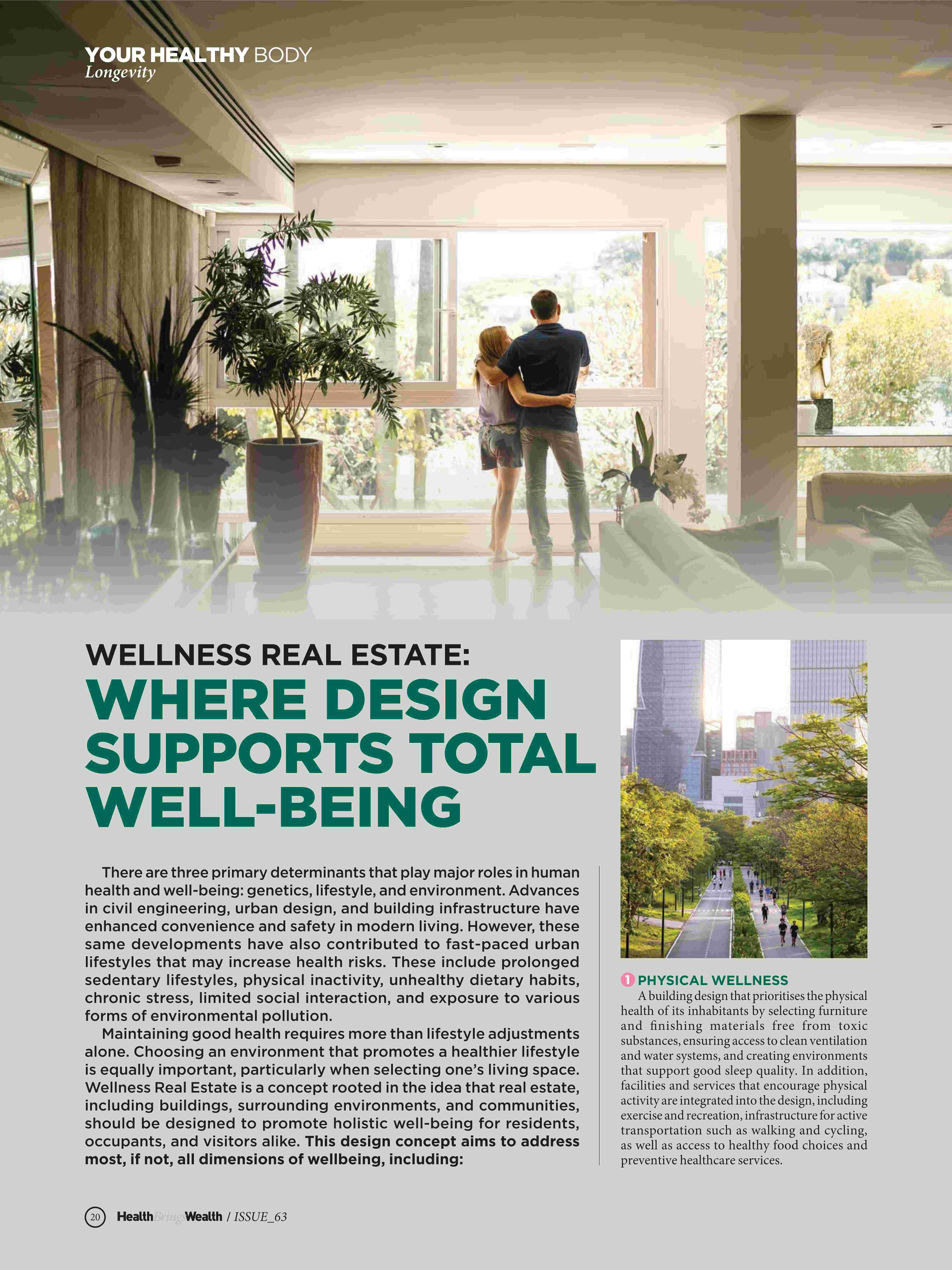
1. Physical Wellness
A building design that prioritizes the physical health of its inhabitants by selecting furniture and finishing materials free from toxic substances, ensuring access to clean ventilation and water systems, and creating environments that support good sleep quality. In addition, facilities and services that encourage physical activity are integrated into the design, including exercise and recreation, infrastructure for active transportation such as walking and cycling, as well as access to healthy food choices and preventive healthcare services.
2. Social Wellness
A designed that foster social interaction by providing thoughtfully positioned living and common areas, equipped with amenities, services, activities that encourage gatherings and enrich social engagement among inhabitants and their neighbors.
3. Mental, Emotional, and Spiritual Wellness
The design emphasizes a strong connection to nature, culture, and tradition, and incorporates quiet areas designated for physical and mental restoration. Residents are provided with spaces for personal hobbies as well as shared spiritual activities, supported by technology that promotes a balanced work-life lifestyle.
4. Environmental Wellness
The design focuses on environmental conservation through the use of recycled and environmental-friendly materials, while prioritizing energy efficiency. Moreover, it also promotes sustainable lifestyles among residents by reducing reliance on private vehicles, providing spaces for gardening, and encouraging food sourcing that supports local producers.
5. Community Wellness
With community and inclusion at its core, the design encourages communal care and development by fostering trust and strengthening a sense of civic responsibility.
6. Economic & Financial Wellness
A community designed to support everyday living such as working, attending school, and shopping through a variety of transportation options and convenient distances. Housing prices are structured to remain affordable, enabling people within the community to achieve homeownership.
A supportive environment is the foundation of longevity
Many studies consistently conclude that green spaces play a vital role in physical and mental well-being, as well as in the quality of life of nearby residents. A 1% reduction in green space is associated with an increase in fine particulate matter (PM2.5) of approximately 10 micrograms per cubic meter, which in turn increases mortality risk by about 1%.
Living in areas with green space correlates to a lower risk of several non-communicable diseases (NCDs), including hypertension, type 2 diabetes, dyslipidemia, and cardiovascular disease. This is because access to green spaces helps promote a healthier lifestyle, which encourages physical activity, reduces stress, lowers exposure to air pollution, and mitigates heat stress caused by the urban heat island effect, whereby building materials such as concrete absorb and retain heat during the day. It is found that living within 500 meters from a green space decreases the risk of cardiovascular diseases by 26-27%, while living within 1,000 meters is linked to a 21-22% reduction. Furthermore, an increase of just one square meter of green space is associated with an estimated 0.002% reduction in all-cause mortality, whereas larger green spaces may reduce overall mortality by up to 0.011%.
Research on urban lighting has shown that areas with high levels of light pollution commonly found in urban settings, such as excessively bright streetlights, illuminated advertising signage, and glare from vehicle headlights, are associated with an increased incidence of breast cancer. This association is more pronounced in areas where light pollution levels exceed 21 pixels, with breast cancer rates reported to increase by approximately 10.9 cases per 100,000 population per year. In addition, individuals who work night shifts and are regularly exposed to artificial light at night face a higher risk of breast cancer compared with others. However, the association between such exposure and the incidence of prostate cancer remains unclear.
These findings underscore the importance of the environment in shaping health and wellness. Building and urban design should therefore extend beyond considerations of aesthetics and comfort to be recognized as integral components of long-term health promotion and care. Creating environments that actively support healthy lifestyles is one of the most sustainable and valuable investments.
References
1. Johnston K, Yeung O, Global Wellness Institute. Wellness Real Estate: Market Growth (2019–2023) and Future Developments. Miami, FL: Global Wellness Institute; 2024 May [cited 2026 Jan 19]. Available from: https://globalwellnessinstitute.org/wp-content/uploads/2024/05/GWI-Wellness-Real-Estate-2024.pdf