

 Appointment
Toxic dust PM 2.5, a deadly killer that destroys health
The PM2.5 toxic dust situation in early 2023 is reaching a critical stage. Many areas almost throughout Thailand, including Bangkok, surrounding areas, Chiang Mai, Lamphun, Nakhon Phanom, etc., face problems with dust exceeding the standard of 50 micrograms per cubic meter. Vision and driving deteriorate. The tall buildings, big and small, look very gloomy when viewed from a distance. Many people feel uncomfortable breathing. “Small dust particles” This created great concern for the people. Especially in families with children, the elderly, and the sick, which is a very big air pollution problem right now.
Air pollution is one of the environmental problems that affect the quality of life of people everywhere. In 2018, the World Health Organization estimated that 9 out of 10 people around the world are breathing bad air into their bodies and estimated that up to 7 million people would die from such pollution per year. From this information, many countries have realized and are making efforts to deal with this problem. But the problem has not decreased and continues to intensify.
Dr. Tanupon Wirunhakarun or Dr. Amp, President of the Bangkok Association of Rehabilitation Doctors and Obesity Education Promotion (BARSO) and Chairman of the Executive Committee of BDMS Wellness Clinic, is concerned about the health effects. Because these pollution problems do not just affect the respiratory system alone. But it can also have a more negative effect on all body systems than you think.
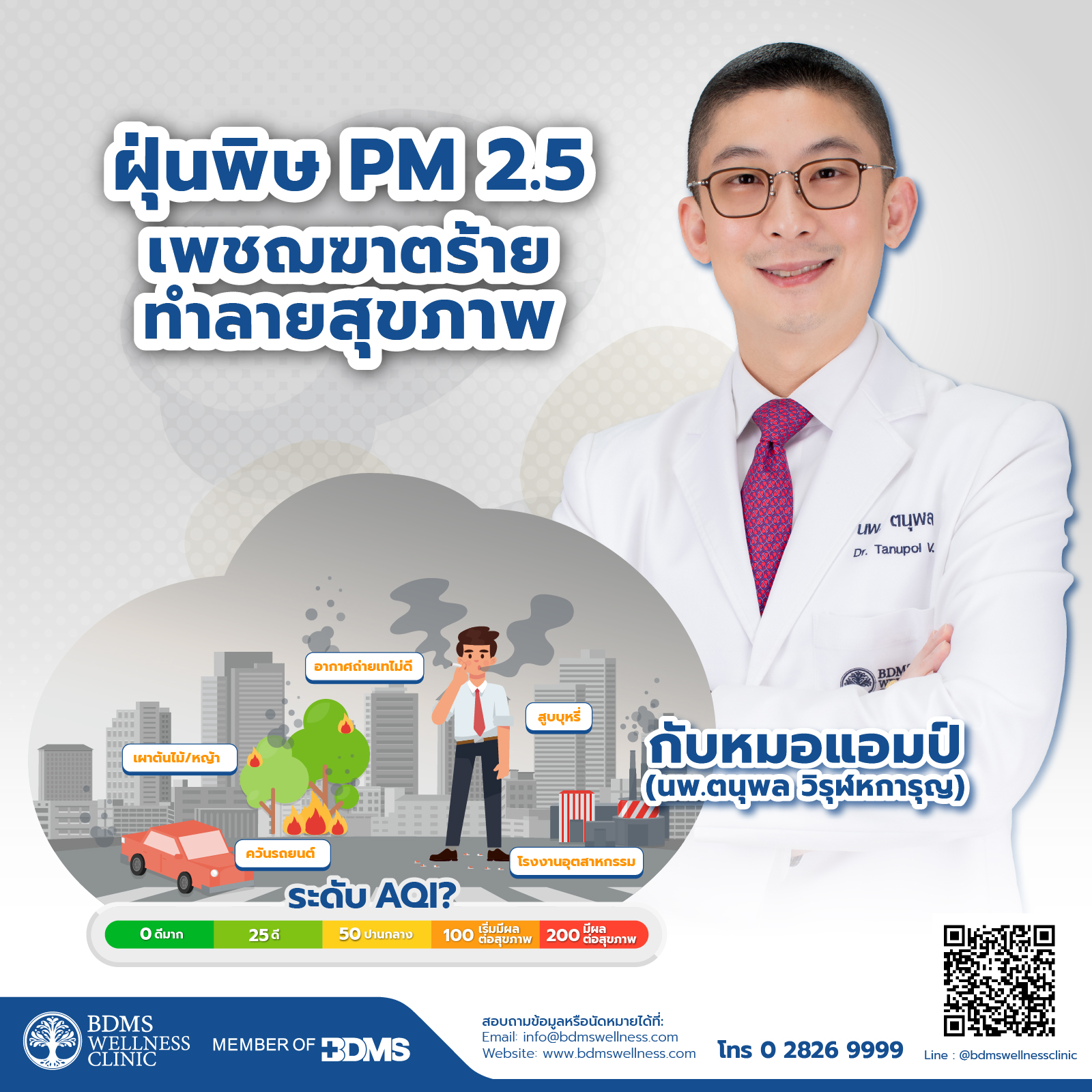
What is PM dust?
Particulate Matter (PM) is small particles consisting of a mixture of solids and liquids suspended in the air. They have different shapes, sizes and chemical compositions, such as inorganic compounds (sulfate, nitrate, ammonia), organic compounds, heavy metals (cadmium, copper, zinc) and polycyclic aromatic hydrocarbons (PAHs). “Various allergens and germs can also be found in these microscopic particles,” added Dr. Amp.
Generally, we tend to classify this particle by its size in microns (micron). That is, if this small dust is no more than 10 microns, it is called PM10 (Coarse particle). If it is no more than 2.5 microns, it is called PM2.5 (Fine particle). And if it is smaller than 1.0 microns, it is called PM1.0 (Ultrafine particle). Currently, we usually pay attention to PM2.5. It is very much a problem and is likely to become more of a problem now.
From the above mentioned PM2.5 which is very small to make it easier to understand. Dr. Amp explains further: “If compared to our hair, This microscopic dust is 20 to 28 times smaller than the diameter of a human hair, and that means it's more likely to enter the body easily and quickly.”
What causes PM2.5?
This toxic dust didn't just happen. But it has been in our daily life for a long time. They generally occur during the transition of the seasons. That is, high pressure from China descends to the upper part of the country, causing the monsoon to weaken. There is a calm wind condition. Combined with changes in temperature causing dust to cluster. Poor ventilation There is an accumulation of dust. Fog and smoke in the atmosphere Until such a phenomenon occurred as we saw. In addition to climate reasons Human activities, both outdoors and indoors, can also promote the generation of PM 2.5 dust.
for outdoor activities These toxic dust particles usually come from the exhaust emissions of general cars, trucks, buses, and cars driving on rough terrain (construction vehicles, locomotives), and from the burning of fuels such as charcoal, forest burning, farmland burning, and grass burning. They also come from the reaction of gases in the atmosphere from industrial plants. and nuclear power plants as well
As for indoor activities or household activities, they can result in PM2.5 toxic dust, such as smoking, cooking (frying, stir-frying, grilling), lighting incense sticks, candles, lanterns, fireplaces, using photocopiers, etc.
What is the AQI value and how much PM2.5 should it not exceed?
For Thailand's criteria The Pollution Control Department will publicize information using the Air Quality Index (AQI), which reports the concentration of 6 types of air pollutants together, including PM2.5 PM10, ozone gas (O3), carbon monoxide gas (CO), nitrogen dioxide gas (NO2), and sulfur dioxide gas (SO2) to make it easier for people to understand. Can be divided into 5 The color level is
? Blue → AQI 0 – 25?
Very good, suitable for outdoor activities.
? Green → AQI 26 – 50?
Good, able to do normal outdoor activities
? Yellow → AQI 51 – 100?
Moderate: You should reduce the time spent outdoors.
? Orange → AQI 101 – 200 ?
Starting to affect health You should watch your health. Use personal protective equipment. If you experience any symptoms, consult a doctor.
? Red → AQI 201 and above ?
Affects health Avoid outdoor activities Use personal protective equipment. If you experience any symptoms, consult a doctor.
Amount of dust in the general atmosphere of Thailand according to environmental quality standards The National Environmental Quality Promotion and Preservation Act of 1992 stipulates that the amount of PM2.5 dust should not exceed 50 micrograms per cubic meter in 24 hours and not more than 25 micrograms per cubic meter per year.
On June 1, 2023, the National Environment Board resolved to set a new PM2.5 dust standard, lowering it to 37.5 micrograms per cubic meter. for a 24-hour average and 15 micrograms per cubic meter. For the annual average It will come into effect immediately from the date of publication in the Royal Gazette.
However, “The new standard is still higher than the new Air Quality Guidelines (AQGs) announced by the World Health Organization (WHO) in September 2021, which is that PM2.5 dust levels should not exceed 15 micrograms per cubic meter in 24 hours and not more than 5 micrograms per cubic meter per year,” added Dr. Amp.
How does PM2.5 affect the body?
PM2.5 dust value 22 micrograms per cubic meter Equivalent to smoking 1 cigarette in 2022. Toxic smoke that people in Bangkok Inhaled is equivalent to smoking approximately 1,225 cigarettes throughout the year. Or an average of 3.36 cigarettes per day. which is considered very dangerous Dr. Amp gave the reason that Because PM2.5 dust is a very small particle. Can penetrate into the human body so deeply that it penetrates the lungs' air sacs. directly into the bloodstream and can have a negative effect on the work of the respiratory system and many other parts, which are as follows
The body is damaged by free radicals and inflammation occurs.
Dust, smoke, and various pollutants can stimulate the creation of a substance called “Free radicals” cause oxidative stress, causing DNA damage, inhibiting DNA repair, and causing abnormalities in the fetus. mutation and other negative effects
In addition, “Free radicals accumulate in the liver. which is an organ that acts like a waste disposal factory within the body It contains important substances like 'Glutathione' that helps in detoxifying. If the body has high levels of this important substance, it will be able to eliminate waste quickly. If there is little, waste will be eliminated slowly. and the more waste received in large quantities It will cause disease and sickness as a result.” Dr. Amp talks about the dangers of free radicals.
shorten telomeres
Telomere is the end of a chromosome. It serves to prevent the genetic code from being destroyed during cell division. Which if we get free radicals like exposure to a lot of air toxins It will cause the telomeres to shrink more than normal. It can cause damage to our genetic code. and is one of the causes of various chronic diseases.
Inducing chronic disease.
PM2.5 dust is associated with increased production of inflammatory substances. with an increased number of white blood cells This inflammatory process that occurs will destroy various cells, causing us, especially children, to have lower immunity. Get colds more often have allergies And various chronic diseases occur, such as diabetes, vascular disease, paralysis, paralysis, and the most serious is It can also cause cancer in the long term. In particular, lung cancer killed more than 122,104 Thai people in 2020, along with this toxic dust containing volatile organic compounds such as polycyclic aromatic hydrocarbons (PAHs), which is why the International Agency for Research on Cancer (IARC) classified this type of volatile substance as one of the carcinogens for humans.
How can we take care of ourselves from PM2.5?
Although at present there are various measures and policies from government agencies However, the general public should also deal with and prevent pollution from entering our bodies. Dr. Amp has therefore recommended basic methods of prevention by taking care of yourself as follows:
- Avoid or reduce the duration of long periods of outdoor activity. To reduce the chance of exposure to dust from outside. Or use self-protection equipment such as an N95 mask if it is necessary to go to an area with a lot of dust.
- Campaign for choosing vehicles and electric public transportation Instead of using fossil fuels such as coal, oil shale, and petroleum.
- Avoid household activities that increase the amount of dust, such as smoking and lighting incense and candles. Reduce the cooking of grilling and grilling foods by choosing boiling and steaming instead.
- Organize your home, such as installing an air filter. It's important to clean it regularly and try to have good ventilation.
- Always observe your symptoms. Especially the elderly Patients with respiratory disease, if they have any symptoms such as coughing, difficulty breathing, red eyes, chest tightness, headache, nausea, fatigue, etc., should consult a doctor immediately.
- Take care of your immune system which is the body's protective armor, including
-
- Eating foods rich in vitamin A, vitamin C, and vitamin E, such as vegetables and fruits. which has antioxidant properties and helps nourish the liver
- Refrain from smoking and drinking alcohol.
- Drink 8 - 10 glasses of clean water per day.
- Get enough sleep 8 - 9 hours a day.
- Reduce stress, brighten your mood
- Exercise regularly (if PM2.5 levels are high, you can adjust to indoor exercise such as running on a treadmill, stationary bicycle, indoor swimming, etc.) for at least 150 minutes per week. or at least 30 minutes per day, 5 days per week.
Air pollution problems Especially PM2.5 dust is considered a serious environmental threat to human health. Although this is not a recent problem and will go away easily. But the increasing violence reinforces the need to take this issue seriously. Because that is an important reflection variable of the health of Thai people both now and in the future.
“During the current crisis, we would like to express our concern to everyone. and campaign for cooperation in reducing pollution. To bring good air back to us and so that our children and grandchildren can live in this present world more safely,” Dr. Amp concluded.
With best wishes fromBDMS Wellness Clinic
LINE: @bdmswellnessclinic or https://lin.ee/Z4So1yQ
Reference list
- World Health Organisation. 9 out of 10 people worldwide breathe polluted air, but more countries are taking action [Internet]. 2018 May 2 [cited 2023 Feb 7]. Available from: https://www.who.int/news/item/02-05-2018-9-out-of-10-people-worldwide-breathe-polluted-air-but-more-countries-are-taking-action
- The California Air Resources Board. Inhalable Particulate Matter and Health (PM2.5 and PM10) [Internet]. 2017 Aug 6 [cited 2023 Feb 7]. Available from: https://ww2.arb.ca.gov/resources/inhalable-particulate-matter-and-health
- The New York State Department of Health. Fine Particles (PM 2.5) Questions and Answers [Internet]. 2018 [cited 2023 Feb 7]. Available from: https://www.health.ny.gov/environmental/indoors/air/pmq_a.htm
- Ministry of Natural Resources and Environment. Announcement of the National Environment Board No. 36 (2010) regarding setting standards for dust particles no larger than 2.5 microns in the general atmosphere. Royal Gazette Volume 127, Special Section 37 (dated 24 March 2010).
- Dust monitoring group Chulalongkorn University. Learn to live with PM2.5 dust [Internet]. Bangkok: Chulalongkorn University; 2019 [Accessed on 7 February 2023]. Accessible from https://www.chula.ac.th/wp-content/uploads/2019/10/Chula-PM25.pdf
- Air Quality and Noise Management Division Pollution Control Department. Air quality index information [Internet]. [Accessed on 7 February 2023]. Accessible from http://air4thai.pcd.go.th/webV2/aqi_info.php
- Xing YF, Xu YH, Shi MH, Lian YX. The impact of PM2.5 on the human respiratory system. J Thorac Dis. 2016;8(1):E69-74.
- Spring News. Shock! Statistics for 2022: Bangkokians breathe PM2.5 dust equivalent to smoking 1,224 cigarettes [Internet]. 27 January 2023 [Accessed 8 February 2023]. Accessible from https://www.springnews.co.th/keep-the-world/climate-change/834787
- Thai Health Promotion Foundation (Thai Health Promotion Foundation). PM2.5 dust is a carcinogen. High risk of death, 70,000 people die per year [Internet]. 2022 [Accessed on 8 February 2023]. Accessible from https://resourcecenter.thaihealth.or.th/article/Dust-PM2-5-is a carcinogen-high risk of death-70,000 people die per year.
- Zhao B, Vo HQ, Johnston FH, Negishi K. Air pollution and telomere length: a systematic review of 12,058 subjects. Cardiovasc Diagn Ther. 2018;8(4):480-92.