

 Appointment
5 important issues with obesity, an uninvited danger
Change your perspective, adjust your thinking, change your life with Dr. Amp.
Change your perspective, adjust your thinking, change your life with Dr. Amp.
5 important issues with obesity, an uninvited danger
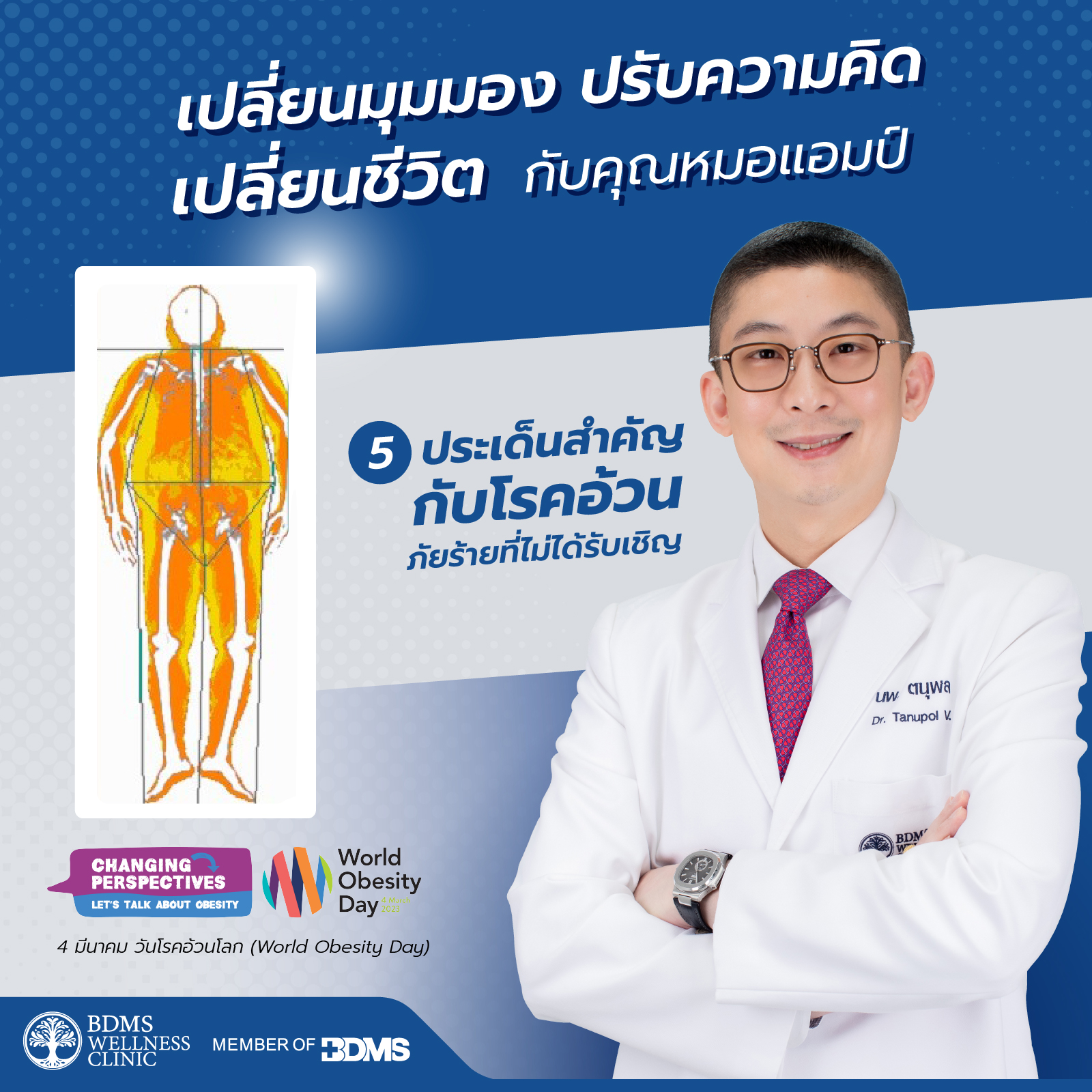
The World Health Organization (WHO) has defined theObesityKeep in mind that it isA disorder in which the body accumulates too much fat to the point of having a negative effect on health.Obesity is an important factor that causes various diseases, including chronic non-communicable diseases. (Non-Communicable Diseases; NCDs) such as type 2 diabetes, cancer, high blood pressure, ischemic or hemorrhagic stroke (stroke), as well as hardened arteries in the heart. (Atherosclerotic Cardiovascular Disease; ASCVD)
The outbreak of the coronavirus 2019 (COVID-19) has further highlighted this. Dangers of obesity When the World Health Organization reported that Obesity patients There is a 7 times greater chance of death and severe illness than normal people.
Dr. Tanupon Wirunhakarun or Dr. Amp The President of the Bangkok Association of Rehabilitation Physicians and the Promotion of Obesity Education (BARSO) and the Chairman of the Executive Board of BDMS Wellness Clinic intend to raise the issue of obesity in the discussion.“World Obesity Day”which falls on March 4th of every year.“Create awareness”and“Stop the increase.”of the obesity crisis within the year 2568
“Obesity is a major threat to Thailand. This can be seen from data from the Department of Health. Ministry of Public Health The reported prevalence of overweight or obesity among adults in 2022 was 47.8%, increasing from 34.7% in 2016, consistent with the report of the Bureau of Nutrition in 2020. It was found that the prevalence of obesity In women it was 46.4% and men 37.8%, an increase from 2010. 2014 with a prevalence of only 41.8% and 32.9% The prevalence of obesity is mainly in Bangkok.

However, another age group that should not be neglected is the childhood group because from the report of the Nutrition Bureau, Department of Health, Ministry of Public Health. School-age children between the ages of 6 - 14 years have obesity and overweight problems, accounting for as much as 13.3%, and children under 5 years of age at 9.07%.”Doctor Amp said.
To create knowledge and correct understanding about obesity. Dr. Amp then brought up5 important points about obesityUp to broadcast to everyone as a starting point for good health.
Myth 1: Obesity is classified as a disease.
“Some of you may not know yet. Obesity is considered a chronic disease just like type 2 diabetes or high blood pressure.”Dr. Amp discusses misconceptions about obesity.
Obesity isA condition in which the body has too much fat accumulated. Until causing abnormalities in the operation of various systemssuch as sleep apnea joint movement problems The immune system is weakened. Including metabolic disorders such as increased sugar levels increased blood pressure Increased inflammation in the body Which can lead to other diseases such as cardiovascular disease and cancer, etc.
Obesity has stages, just like any other disease. The American Association of Clinical Endocrinologists (AACE) has defined 3 main stages:
- Distance 0or a condition where there is adipose tissue, but no complications have been found.
- Phase 1or the period when there is at least one mild to moderate complication related to obesity.
- Phase 2or the period when there is at least one severe complication related to obesity.
“Obesity is not just a risk factor for disease. or the results of life choices But obesity is a disease that can cause many complications.”Dr. Amp emphasizes the dangers of obesity.
Myth 2: Body weight alone cannot indicate obesity.
In general, body mass index or BMI is often used as a criterion for determining obesity. People who are overweight will have a BMI of 25 kilograms per square meter or more. And obese people will have a BMI of 30 kilograms per square meter or more. But BMI may not actually be a very accurate tool. In assessing obesity Because body composition cannot be assessed, such as people with the same BMI. There may not be the same proportion of muscle and fat. For example, bodybuilders have more muscle than people who lack exercise.
Dr. Amp recommends that BMI should not be used for diagnosis alone. Other tools should be used, such as measuring waist circumference or measuring body composition with a DEXA (Dual-Energy X-ray Absorptiometry) machine to assess the proportion of total body fat. In the middle-aged group (ages 20 - 50 years), women should not have more than 32% fat and men should not have more than 28%.

Myth 3: Obesity is caused by many factors. It's not just about eating too much food.
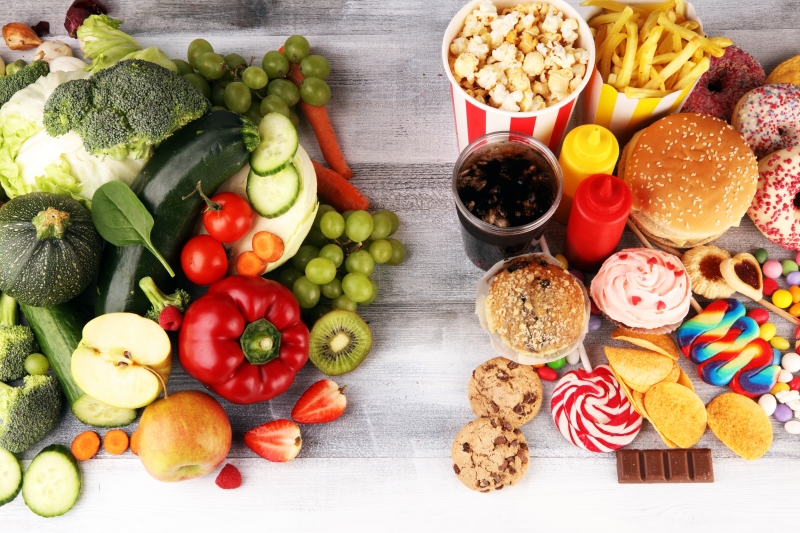
People often understand that If we eat large amounts of food, it can cause us to gain weight. Because caloric energy depends on the amount of food. But don't forget that The same amount of food May provide different energy For example, 100 grams of apple provides 50 kilocalories of energy, while 100 grams of chocolate bar provides 400 kilocalories, depending on the energy density of the food. According to the proportion of nutrients, carbohydrates, proteins, and fats, carbohydrates and proteins provide 4 kilocalories of energy per gram. and fat is 9 kilocalories per gram.
Therefore, eating To prevent and treat obesity It's not just about limiting quantities. But quality must be considered in the right amount. Foods that are high in dietary fiber or fiber, such as vegetables, fruits, or whole grains. They often provide less energy than foods high in fat and sugar. It also contains other nutrients that are necessary for the body, such as vitamins, minerals, and various antioxidants. In order for the body to function normally
The occurrence of obesity There are also many causes combined. Whether it's exercise, sleep, hormonal function. to various genetic codes. All of this affects the body's energy metabolism system. Therefore, various lifestyle modifications (Lifestyle Modification) must be taken into account at the same time.
Myth 4: The fatter you are, the more difficult it will be to control your eating.
Obesity is caused by an imbalance in the body's control of hunger and satiety. which is controlled by the nervous system and endocrine glands (Neuroendocrine) The endocrine glands create hormones that can send signals to the brain telling us whether we should continue eating or not.
Important hormones are The hormone leptin (Leptin) makes the body feel full. This hormone is secreted from fat cells. and will secrete more according to the number of fat cells in the body If we don't get enough sleep, the secretion of the hormone leptin will decrease. Your appetite for food will increase.
“In people who are obese, they have leptin resistance, meaning the body does not respond to leptin's satiety signal. makes you not feel full and never stop eating.”Dr. Amp explains the causes of increased appetite.
The hormones that work in opposite ways are Ghrelin, or hunger-stimulating hormone Will secrete a lot before meals. and will decrease when starting to eat in people who are obese The secretion of the hormone ghrelin is abnormal. Even after eating, ghrelin levels did not decrease. Makes the appetite not decrease
Therefore obesity Therefore, it is not just a lack of restraint (Willpower) to stop eating. But it is also a matter of hormonal imbalance in the body.
Myth 5: Obesity is a result of both genetics. and environment
Nowadays, there are quite a few people who understand that Obesity is a genetic disease. Because it is often found that if people in the family are obese, it will be passed on to the next generation. Genetic code that is involved in obesity, such as FTO or Fat Mass and Obesity-Associated Gene, etc. But genetic code is not the only cause of obesity. An even more important factor is Lifestyle
Doctor Amp explains that Consumption behavior Choosing to buy foods that are high in sugar, high in fat, or processed foods (Processed Foods) also plays an important role. Including the culture in the family and social environment as well.
Although internal factors such as heredity or genes are things that have been with us since birth and cannot be changed. But there are many other external factors that cause obesity. We can control and change it if we adjust our behavior. Take care of our health We will be able to avoid obesity.

In addition, Dr. Amp also recommends simple health care guidelines to keep away from obesity, including 7 points as follows:
- Choose good food that is beneficial to your body. In one dish, 50% is vegetables, another 25% is good quality protein such as fish, nuts and grains, and the last 25% is whole grain flour such as brown rice.
- Avoid foods that are high in fat. Especially trans fats and saturated fats.Such as fatty meat, animal skin, offal, cakes, fast food, bubble tea, processed meat such as bacon, sausage, ham, fermented pork, Chinese sausage, sausage, pork slices, pork sausage, meatballs, sun-dried beef, surimi, etc.
- Avoid bakery foods. and foods high in sugarIn particular, some beverages contain High Fructose Corn Syrup (HFCS) such as sweetened drinks, soft drinks, syrups, fruit juices, jams, candies, cookies, ice cream, cakes, pies, etc.
- Exercise regularlyAt least 150 minutes per week or at least 30 minutes 5 days per week.
- Get enough sleep.At least 8 - 9 hours every day and should go to bed before 10 PM.
- dRefrain from drinking alcoholic beverages and refrain from smoking.
- relieve stressBy meditating, walking, or doing activities that make the brain calm and rest.
Today, Thai people, both young and old, There is an increasing trend of obesity including abdominal obesity. It is something that everyone should be aware of and give importance to. Because obesity is the main cause of various illnesses, eventually affecting the quality of life, Dr. Amp would like to take this opportunity.World Obesity Day Take part in the campaign to fight the obesity problem. To create a healthy society together
“Good health is not for sale. If you want it, you have to do it.”Dr. Amp has a final word.
With best wishes from BDMS Wellness Clinic
LINE: @bdmswellnessclinic or https://lin.ee/Z4So1yQ
Reference list
- WHO. Obesity and Overweight [Internet]. World Health Organisation. WHO; 2021. Available from: https://www.who.int/news-room/fact-sheets/detail/obesity-and-overweight.
- Wichai Ekkapalakorn, Hathaichanok Phakcharoen and Waraporn Sathiannoppakao, editors. Report on the 6th survey of Thai people's health by physical examination 2019 - 2020 [Internet]. Bangkok: Faculty of Medicine Ramathibodi Hospital Mahidol University; October 2020 [Accessed on 9 January 2023]. 346 pages. Accessible from:https://www.hsri.or.th/media/printed-matter/detail/13443.
- Office of Nutrition. Reporting results of analysis according to indicator 1.11 Percentage of children aged 6-14 years old, proportionately tall, Office of Nutrition, 5-month period after 2022. [Internet]. Nonthaburi: Nutrition Bureau, Department of Health, Ministry of Public Health; 2022 [Accessed on 6 January 2022]. Accessible from https://nutrition2.anamai.moph.go.th/web-upload/6x22caac0452648c8dd1f534819ba2 f16c/filecenter/file/doc/1.11AssessmentRound2-2565.pdf.
- Rubino F, Puhl RM, Cummings DE, Eckel RH, Ryan DH, Mechanick JI, et al. Joint international consensus statement for ending stigma of obesity. Nature Medicine. 2020 Mar 4;26(4):485–97.
- Bays HE, Golden A, Tondt J. Thirty Obesity Myths, Misunderstandings, and/or Oversimplifications: An Obesity Medicine Association (OMA) Clinical Practice Statement (CPS) 2022. Obesity Pillars. 2022 Sep;3:100034.
- Garvey WT, Mechanick JI, Brett EM, Garber AJ, Hurley DL, Jastreboff AM, et al. American Association of Clinical Endocrinologists and American College of Endocrinology Comprehensive Clinical Practice Guidelines For Medical Care of Patients with Obesity. Endocrine Practice. 2016;22:1-203.
- Department of Health, Ministry of Public Health. Surveillance information [Internet]. Information system supporting health promotion and environmental health. 2022 [Accessed on 13 January 2023]. Accessible fromhttp://dashboard.anamai.moph.go.th/dashboard/nutri1859/index?year=2022