

 Appointment
World Obesity Day 2026
At present, Overweight and obesity have evolved into an increasingly complex global public health problem. It is not only a major risk factor for chronic non-communicable diseases.

“8 billion reasons to reform the system Fighting the obesity crisis”
At present, Overweight and obesity have evolved into an increasingly complex global public health problem. Not only is it a major risk factor for chronic non-communicable diseases (Non-communicable Diseases: NCDs) It also directly affects the quality of life of the population, as well as causing economic and social burdens from healthcare costs and long-term productivity losses.
The environment of modern society is conducive to the consumption of high-energy foods. With a sedentary lifestyle and access to comprehensive health options, obesity has become a problem at any age. This situation clearly reflects that obesity is not just a result of personal behavior. Rather, it is the result of systemic factors, including the food system, community structure, It is necessary to urgently address the issues of the environment, to related public policies, which need to be addressed seriously, concretely, and continuously.

On the occasion of "World Fat Day" (World Obesity Day)” March 4 2569 Under the concept of driving systemic obesity solutions. Dr. Tanupol Wirulahakarun or Dr. Amp, Chairman of the Board of Directors of BDMS Wellness Clinic, Bangkok Dusit Medical Public Company Limited and President of the Association of Doctors for Health Rehabilitation and Promotion of Obesity Education, Bangkok (BARSO) It will invite all sectors to understand obesity in all dimensions. Ready to promote cooperation to change the system in a sustainable manner. Towards building a healthy Thai society together.
The world is facing an obesity society.

World Health Organization data (WHO) It was revealed that in 2022, more than 2.5 billion adults aged 18 and over were overweight worldwide. Think of it as4%4 of the population, which has increased significantly in the past 30 years to only 25 percent. The prevalence of overweight in Southeast Asia and Africa is 31 percent, while the Americas have a prevalence of 67 percent.

World Obesity Federation (WOF) revealed that nowadays, more people 1 ThousandMillionFacingObesity Or moreThe global prevalence has more than doubled from 2019. 2533 However, The World Obesity Federation also predicts that: By 2035 It could have a population of up to 4 billion people, or half of it.That mustFacing obesity
Another population group that is equally worrisome is the childhood group. 2568 In the past, younger 543 Millions of people are living with overweight and obesity. 159 This is a significant increase from the data of WHO InYear 2533 There is only 31 This reflects the severity of the obesity problem in the global child and youth population.
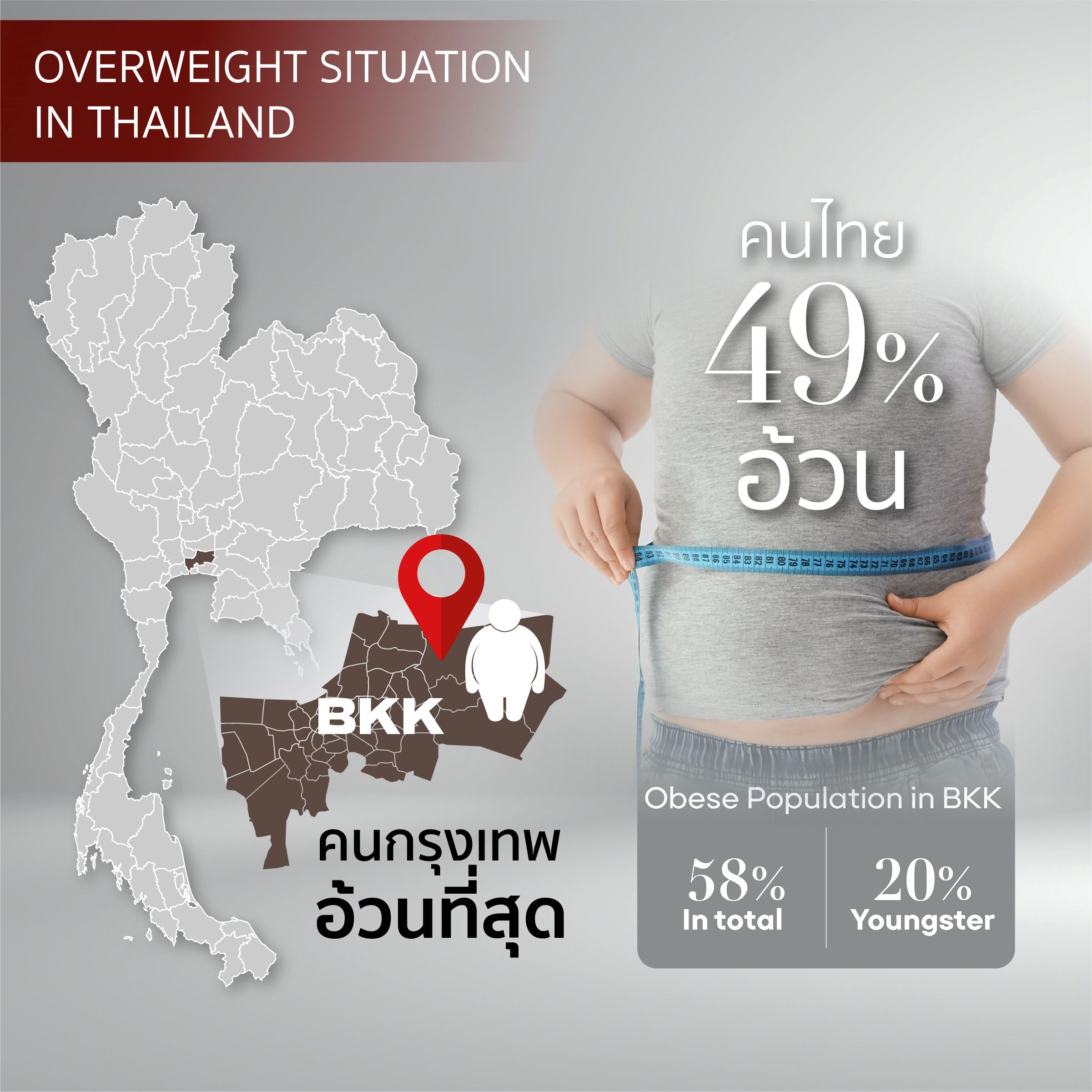
For Thailand Reports from the Medical and Health Warehouse System Ministry of Public Health In monitoring obesity and obesity. In 2014 2567 Past The Thai population is overweight and obese. 49.0% Meanwhile, Bangkok has a prevalence rate of obesity at 58% and more than 20% of children are overweight or obese.
These numbers are sending a warning signal to everyone that obesity is no longer just a personal health problem. Rather, it is a global structural health crisis that is rapidly expanding at all ages. If we do not accelerate serious adjustments. The impact will not stop at statistics, but will inevitably burden the public health system, the economy, and the quality of life of future generations.
Obesity: Redefining Factors That Destroy Health
The current understanding of obesity is about to be reinterpreted, it is a disease that occurs in modern lifestyles and is eating away at each person's body until it becomes necrosis, destroying health at the individual level. Society, health and public health systems around the world.

Originally, the benchmark used to assess obesity (Obesity) are often limited toBMI (BMI) But in reality, “Value Usage BMI It alone may not reflect the amount of adipose tissue (Adipose tissue) This can be related to other chronic diseases in the future.” Dr. Amp said. “Currently, the diagnosis of obesity should also consider other components, especially body composition. (Anthropometric component)” For example:
- Waist circumference measurement (Waist Circumference, WC) It must be considered by gender, race, for example, in Asian and Central Americans. Males and females should not exceed 90 centimeters and 80 centimeters, respectively, etc.
- Using the Machine Dual-Energy X-ray Absorptiometry or DEXA In the middle-aged group. Men should have no more than 25% of body fat, and women should not exceed 32%, which points to a risk.Metabolic aspects related to cardiovascular diseases

Although adipose tissue plays a role in storing energy and producing hormones that control appetite.Hormones are secreted in the digestive tract by sending signals to the brainstem and hypothalamus.However, having too much adipose tissue can cause hormones in the body to be imbalanced.
- Leptin hormone (Leptin) – Plays an important role in regulating the body's satiety.It correlates with the amount of fat cells available. When the body accumulates more fat. The body tries to secrete more leptin, resulting in leptin resistance (Leptin resistance) That is, the appetite does not decrease, even when leptin levels are already very high.
- Ghrelin hormone (Ghrelin) – Plays a role in controlling hunger The reward system of the brain Awareness and decision making It is usually secreted abundantly before meals and decreases after eating. In obese people, ghrelin levels do not decrease after meals. This makes the appetite persistent.
- The hormone clocystokinin (Cholecystokinin, CCK) – When eating fatty foods, gastric juice and enzymes that help digest food are secreted, along with sending signals to the brain to feel full.
- Hormones Peptide Y (PYY) – Works with hormones GLP-1 To control sugar levels and slow down the movement of food. It helps us stay full longer and eat less.
- Hormones Glucagon-like Peptide-1 (GLP-1) – Helps regulate sugar and satiety. Stimulates metabolic processes, stimulates the secretion of the hormone insulin from the pancreas, causing food to move slowly until satiety occurs.
- Hormones Glucose-dependent insulinotropic polypeptide (GIP) – It promotes fat cells to absorb and accumulate more fat. Especially high-fat foods, in people with obesity, there is an excessive secretion of this hormone. It is also associated with insulin resistance.
More than that. An association with inflammatory signaling has also been found when there is a large amount of adipose tissue. Fat cells and immune cells in adipose tissue produce cytokines, such as: IL-1 IL-6 and TNF-α Including indicators of inflammation in the bloodstream such as C-reactive protein (CRP) As a result, the body is in a low level of chronic inflammation (Chronic Low-grade Inflammation) This interferes with the function of the hormone insulin and fat burning processes. This results in insulin resistance and vascular disorders, and increases the risk of chronic diseases such as type 2 diabetes. Diseaseshardening of the arteries; Fatty liver associated with metabolic disorders (MASLD) Heart disease Neurological disorders and cancer
Therefore, the evaluation and diagnosis of obesity Therefore, calculations should not be made only from the numbers on the scales and tape measure. Because of the example of a study last year. from Yale University in collaboration with Harvard University in the United States. It was found that if used, BMI It is the only criterion. About 43 percent of Americans are classified as obese, but when the criteria are adjusted using the waist-to-height ratio and the waist-to-hip ratio, the criteria are adjusted. The prevalence increased to 75.2 percent.
"Watching BMI That alone may allow us to see a lower number of people with excess fat accumulation." Dr. Amp explained.
In addition to assessing body composition, we should also evaluate other factors, including laboratory analysis, hormonal tests, as well as genetic code tests or health blueprints related to obesity, such as: MC4R (Melanocortin-4 receptor) POMC (Proopiomelanocortin) FTO (Fat Mass and Obesity-Associated Gene) LEPR (Leptin receptor) LEP (Leptin) and ADIPOQ (Adipocyte-, C1q-, and collagen domain-containing) Understanding our own body in what we can't see with the naked eye will help us take care of our health more locally.
From a physical mechanism to a national policy drive.
Today's obesity crisis goes beyond just a matter of “Imbalance within the body” Because what we are facing is not just an abnormal hormonal or metabolic mechanism. Rather, it is the result of the modern social context that is shaping people's behavior every day without us realizing it. It's easier than ever to access foods that provide high energy but low nutritional value. The city is designed for us to sit rather than walk. And many health systems still focus on treating diseases rather than systematically preventing them. These external factors are quietly working together and driving obesity to intensify at the population level.
If we focus on only one person, We may only solve the problem.” Dr. Amp said. “Because obesity does not affectBut it reflects the challenges of the entire system, from the food system, the economic system, The burden of chronic non-communicable diseases continues to increase around the world.” The World Obesity Federation also predicts that by 2030, overweight and obesity will have an economic impact of up to US$3.23 trillion, reflecting that this problem is not just a health issue, but a structural challenge for humanity.

- Food System (Food System) that pushes us into a state of risk.
Many modern dishes are designed to “High power, low cost and easy access” Especially foods that have undergone advanced processing (Ultra-processed food)These include cookies, ice cream, cakes, pies, cakes, Fast Food Bubble Tea and also processed meats (Processed meat)Such as bacon, sausages, ham, jam, sausages, sausages, pork slices, pork sausages, meatballs, etc., which have a lot of academic evidence pointing to the health effects.High glycemic load) This can interfere with satiety signaling between the gut and brain. Contamination of carcinogens during the production process and certain food additives associated with intestinal microbial imbalances and inflammation, etc.
Meanwhile, fresh food Vegetables, fruits, and nutritious foods are expensive or difficult to access. In addition, food marketing promotes the consumption of high-sugar beverages such as sweet drinks, soft drinks, syrups, etc. Fruit juices, especially for children and youth, which stimulate hunger mechanisms. The brain's reward system causes unconscious overconsumption.
Solution:Making healthy food an accessible and tangible option for everyone through policy measures such as sugar taxation. Salinity taxation, fat taxation, processed food tax, food marketing control for children. Developing Easy-to-Understand Nutrition Labels Supporting Local Agriculture
In addition, health knowledge should be promoted through television and social media, such as healthy food pillars (50% vegetables, 25% good quality proteins such as fish, tofu, nuts, and whole grains, and 25% whole grains), trans fats and saturated fats, etc.
- Unhealthy environment (Unhealthy Environment)
Cities in various areas are designed to make unhealthy living the norm. Using a car rather than walking Green space and safe sidewalk areas are not enough. Workplaces that emphasize prolonged sitting, long working hours, and a fast-paced lifestyle all lead to a decrease in physical activity among people in society. At the same time, Children of all ages spend more time on screens than outdoors. These unhealthy environments Therefore, living an active lifestyle is not easy. Although it should be a part of daily life.Day
Solution: It is necessary toDesigning a well-being city (Healthy City Design) Healthy Building Development (Wellness Real Estate) Increase public spaces, support public transportation, bicycle paths and sidewalks. Creating schools and workplaces that are conducive to physical activity so that physical activity is a part of life. Without being forced to do it.
- Barriers in the health service system (Healthcare Barriers)
Although obesity is recognized as a complex chronic disease that involves many organ systems, many health systems have not been able to integrate obesity prevention and treatment into primary care services. Many patients have not yet reached the assessment of body composition. Multidisciplinary care or even medication In addition, the bias of healthcare personnel can cause patients to avoid receiving services.
“If the health system still sees obesity as only a risk factor, not a chronic disease that requires continuous care. A large number of patients will still not be able to access proper care.” Dr. Amp emphasized.
Solution:PushA national health policy that integrates the prevention and treatment of chronic non-communicable diseases. Cultivating an in-depth understanding of obesity Creating an effective referral system and ensuring that all groups of people have equal access to quality services.
Solving the obesity crisis cannot only focus on adjusting the behavior of the person, but must adjust it. “System” That shapes these behaviors, from the food system that determines what we eat. The urban environment that determines the quality of life, to the health service system that must be ready to take care of continuously and equitably. If we can make a healthy alternative the most accessible option, we can make it the most accessible option. Obesity will not only be a burden to be treated, but will become a problem that can be prevented sustainably at the social and national levels.
On the occasion of this year's World Obesity Day. Under the concept of “8 Billion Reasons to Act on Obesity” Numbers 8 Billions are not just the world's population. If it is: 8 Billions of reasons why we all need to take action, from passing on health knowledge and understanding body mechanisms at the individual level. Jointly designing a conducive environment to promoting food policy. To transform the system, make healthy choices the most accessible option, and improve people's quality of life in a sustainable manner together.
“Today's obesity is no longer anyone's problem, and no one can solve it alone. This is a challenge for the entire system, from the family, community, government, private sector to the international arena. If we continue to let the environment determine the health of the next generation, we will not be able to do so. We will face a more severe obesity society. It's time for us to work together to change the system. To stop this obesity crisis and create a healthy and sustainable future for our children.” Dr. Amp concluded his remarks.
References:
[1]NCD Risk Factor Collaboration. Worldwide trends in underweight and obesity from 1990 to 2022: a pooled analysis of 3663 population-representative studies with 222 million children, adolescents, and adults. The Lancet 2024. 16;403(10431):1027-1050.
[2]Kanokwan Born Phalanan. Bangkok, City for Better Health 3 Coordinate to create health for urban people to avoid obesity [Internet]. Bangkok: Bangkok Business Media Co., Ltd.; 11 Nov 2568 [Accessed on 21 Jan 2569]Accessible from https://www.bangkokbiznews.com/health/well-being/1207038
[3]Nadolsky K, Garvey WT, Agarwal M, et al. American Association of Clinical Endocrinology Consensus Statement: Algorithm for the Evaluation and Treatment of Adults with Obesity/Adiposity-Based Chronic Disease - 2025 Update. Endocr Pract. 2025;31(11):1351-94.
[4]Aryee EK, Zhang S, Selvin E, Fang M. Prevalence of Obesity With and Without Confirmation of Excess Adiposity Among US Adults. JAMA. 2025;333(19):1726–28.
[5]Hogan AE, Davis C, Jenkins BJ, Jones N, O'Shea D. Repurposing metabolic drugs as anti-inflammatory agents. Trends Endocrinol Metab. 2025. Trends Endocrinol Metab. 2025 Aug 13:S1043-2760(25)00149-3.
[6]Rubino F, Cummings DE, Eckel RH, Cohen RV, Wilding JPH, Brown WA, et al. Definition and diagnostic criteria of clinical obesity. Lancet Diabetes Endocrinol. 2025;13(3):221-62.
[7]Son JW, le Roux CW, Blüher M, Nauck MA, Lim S. Novel GLP-1-Based Medications for Type 2 Diabetes and Obesity. Endocr Rev. 2025 Oct 7:bnaf036.
[8]Al-Roub NM, Malik D, Essa M, et al. Body Mass Index and Anthropometric Criteria to Assess Obesity. JAMA Netw Open. 2025;8(12):e2549124.
[9]Hall KD, Hammond RA, Rahmandad H. Dynamic interplay among homeostatic, hedonic, and cognitive feedback circuits regulating body weight. Am J Public Health. 2014;104(7):1169-75.
[10]Campos A, Port JD, Acosta A. Integrative Hedonic and Homeostatic Food Intake Regulation by the Central Nervous System: Insights from Neuroimaging. Brain Sci. 2022;12(4).
[11]Baker P, Machado P, Santos T, Sievert K, Backholer K, Hadjikakou M, et al. Ultra-processed foods and the nutrition transition: Global, regional and national trends, food systems transformations and political economy drivers. Obes Rev. 2020 Dec;21(12):e13126.
[12]Monteiro CA, Cannon G, Levy RB, Moubarac JC, Louzada ML, Rauber F, et al. Ultra-processed foods: what they are and how to identify them. Public Health Nutr. 2019 Apr;22(5):936-941.
[13]Global action plan on physical activity 2018–2030: more active people for a healthier world. Geneva: World Health Organization; 2018. Licence: CC BY-NC-SA 3.0 IGO.
[14]Sallis JF, Cerin E, Conway TL, Adams MA, Frank LD, Pratt M, et al. Physical activity in relation to urban environments in 14 cities worldwide: a cross-sectional study. The Lancet. 2016;387(10034):2207-17.
[15]World Health Organization. Make obesity prevention and management a central pillar of public health, experts urge [Internet]. Geneva: World Health Organization; 2025 April 1 [cited 2026 Feb 1]. Available from: https://www.who.int/europe/news/item/01-04-2025-make-obesity-prevention-and-management-a-central-pillar-of-public-health-experts-urge