

 Appointment
Immune supplements To take care of women's health
Girls should know! Immune supplements To take care of women's health
Today many women Work both inside and outside the home. Having many roles in life This may cause you to have no time to take care of your own health. And as age increases, various systems within the body will deteriorate over time. Including a less effective immune system. This causes the body to protect itself from pathogens, viruses, and various foreign substances to decrease as well.
One of the ways to take care of your health is Eating nutritious food There are important nutrients that play a role in promoting normal immune system functioning. 4 important nutrients that women should eat include:
Protein
Major nutrients that are essential to the body. It is an important component in building various cells. If the body lacks protein It will affect the division of cells involved in the immune system. Including the creation of enzymes and various compounds that are necessary in the structure of proteins, consisting of various types of amino acids. Some types play an important role in the body's immunity, such as:
- Arginine (Arginine) is an amino acid that the body can synthesize. But in some conditions the body may not create enough to meet the needs. Is important to the function of lymphocyte white blood cells (Lymphocyte), which are responsible for catching and eating foreign substances. and healing of scars, including stimulating the secretion of Growth Hormone, which is an important hormone related to aging. reduction of growth hormone As a result, muscle mass decreases. Fat mass increases and the efficiency of skin cell turnover decreases.
- Glutamine (Glutamine) is an amino acid that is important in the process of creating antioxidants. It is necessary for the creation of the enzyme glutathione. (Glutathione) and plays a role in the development of gastrointestinal system cells. which is an important barrier of the immune system in the body
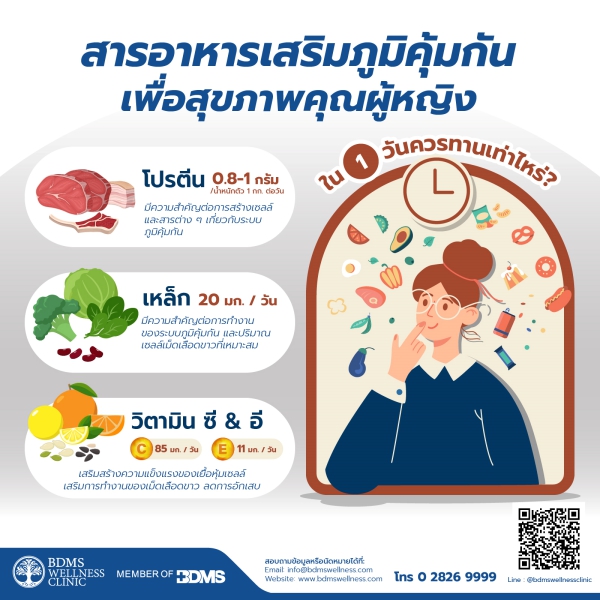
Women should get 0.8-1 gram of protein per 1 kilogram of body weight per day If you are a pregnant or breastfeeding woman, your protein needs will increase. You should choose a good source of protein, such as grains, various types of nuts, fish, tofu, and to get all essential amino acids. You should eat protein from a variety of sources.
Iron
It is a mineral that is important for the functioning of the immune system. Women of childbearing age are at higher risk of iron deficiency than men. Iron is found in abundance in foods such as meat. Green leafy vegetables and dried beans The Department of Health recommends the quantity needed to be 20. milligrams per day in women aged 19-50 years and reduced to 10 mg per day When over 50 years old
Iron is stored in many parts of the body. Whether it is red blood cells, liver, muscles, bone marrow, including white blood cells (macrophages). Iron deficiency will affect the macrophages' ability to eat foreign substances.
In addition, iron deficiency affects the innate immune system (Innate Immunity) and the specific immune system (Adaptive Immunity), causing the number of T-cell lymphocytes to decrease because of a defect in the proliferation process. Reduces the reaction of the myelin peroxidase enzyme. (Myeloperoxidase: MPO) that plays an important role in destroying pathogens. And iron deficiency also causes the function of natural killer cells to weaken.
Iron is important for the immune system. But iron supplementation in the form of dietary supplements without consulting a doctor There may be a risk of consuming too much iron. Until causing side effects regarding the digestive system or in the long term May accumulate in internal organs Until damage can occur Therefore, you should consult your doctor before taking iron supplements.
Vitamin C and Vitamin E
It has outstanding effects in the process of neutralizing free radicals (Free Radical) and plays an important role in balancing the immune system in many ways.
- Builds strength of the epithelium. The skin is the first layer of defense to protect the body from various infections. Concentration of vitamins in the epidermis There will be more than the dermis layer. Can help protect cells from being damaged by free radicals from outside. Vitamin C is a cofactor of the enzymes Prolyl hydroxylase and Lysyl hydroxylase that play an important role in the creation and maintenance of collagen. It also promotes the development of keratinocytes. (Keratinocyte) into skin cells and causes fibroblast cells to divide and move. Helps reduce the time needed for wound repair and recovery.
- Increase the ability to trap foreign objects. Vitamin C and vitamin E that are accumulated in neutrophil and monocyte white blood cells help prevent damage that occurs from oxidative bursts when white blood cells attack foreign substances. As a result, the process of removing foreign matter can occur better. Reduce cell injury caused by this process. and helps the death of white blood cells after ingesting foreign substances occur according to the normal mechanism. (Apoptosis)
- Promotes the function of white blood cells, lymphocytes. Like neutrophils, white blood cells Lymphocytes store vitamins in their own cells. To promote cell proliferation (Proliferation) and development of T cell lymphocytes into their full form. Supplementing with vitamin C and vitamin E There are also reports of an association with increasing immune levels (Antibody Level) of immunoglobulins. (Immunoglobulin; Ig) types IgM, IgG, IgA that are important for protecting the body from various infections.
- Reduces inflammation. Vitamin C and Vitamin E It plays an important role in increasing IL-10 (Interleukin 10) which is an anti-inflammatory substance. And helps reduce inflammatory substances such as TNF-α and IL-6, etc. Helps reduce the level of histamine that is produced when responding to foreign substances. By increasing the circulation of histamine in the blood It helps reduce allergic reactions such as watery eyes and runny nose caused by histamine.
Vitamin C
It is a water-soluble vitamin. Found in many fruits and vegetables such as grapefruit, guava, papaya, gooseberry, kale, broccoli according to the recommendations of the Department of Health. Women need 85 milligrams of vitamin C per day. Pregnant women should get an additional 10 milligrams per day. Breastfeeding women should get an additional 60 milligrams of vitamin C per day.
However, research has found that Vitamin C supplementation 250 mg per day In people with vitamin C deficiency Helps increase the efficiency of the movement of neutrophil white blood cells to the area of infection (neutrophil chemotaxis) and supplementing with 1 gram of vitamin C per day along with vitamin E in elderly women. Helps increase the efficiency of white blood cells, neutrophils. In addition, there is research that reports that Supplementing with 125-1,000 milligrams of vitamin C per day. Helps reduce histamine levels in allergy sufferers. and vitamin C supplementation of 200 milligrams or more. Helps to reduce the severity of Duration and incidence of colds.
Vitamin E
It is a fat-soluble vitamin. Found in foods such as oils such as rice bran oil, soybean oil. Including various seeds, the Department of Health recommends that women need 11 milligrams of vitamin E per day.
In addition to taking care of nutrition, exercise Quality sleep and managing stress All affect the immune system. Every woman should turn to take care of their overall health. To keep the immune system functioning strong Have good health and a long, quality life.
Best wishes from BDMS Wellness Clinic
LINE: @bdmswellnessclinic or https://lin.ee/Z4So1yQ
Thank you for the information from
- Carr A, Maggini S. Vitamin C and Immune Function. Nutrients. 2017;9(11):1211.
- Weber P, Birringer M, Blumberg J, Eggersdorfer M, Frank J. Vitamin E in human health. 2019.
- Cherayil B. Iron and Immunity: Immunological Consequences of Iron Deficiency and Overload. Archivum Immunologiae and Therapiae Experimentalis. 2010;58(6):407-415.
- Karacabey K. The Effect of Nutritional Elements on the Immune System. Journal of Obesity & Weight Loss Therapy. 2012;02(09).
- Coad J, Conlon C. Iron deficiency in women. Current Opinion in Clinical Nutrition and Metabolic Care. 2011;14(6):625-634.
- Shervington, A., & Al-Tayyem, R. (2001). Arginine. Profiles of Drug Substances, Excipients and Related Methodology, 27, 1-32.
- Nutrition Division, Department of Health, Ministry of Public Health. (2020). Reference amount of nutrients that should be received daily for Thai people in 2020.